Uncategorized

The power to turn insight into action

March 2019


“Social media listening  is an endless source of real time customer insight. You can listen and track data from digital conversations to find new opportunities, create actionable insights and share targeted, relevant content to influence your audience.


I’m going to start this blog with a question. We have all dreamt of having a superpower bestowed upon them. Or is that just me? But if you could have any superpower, what would it be?  

I understand that not all superpowers are created equal. But, consider this. 

What if you could listen to millions of conversations your customers are having, at the touch of a button? What if you could accurately predict the type of content and offers that will influence their decision to buy or stay loyal to your brand? 

Well that day could be closer than you think. Say hello to Delve Insights – our intelligent social listening insight tool.  

In a first for foodservice. Delve Insights gives you the competitive edge. We’ve developed this clever tool to help you understand what your audience has to say about you, your competitors, and your market in general.  

Use Delve Insights to create bespoke research for you and your clients and receive unique insights to gain market advantage. Collect and act upon the data that’s most important to you.  

When you can make informed decisions with real insights, why would you leave it up to guesswork?  

To give you an idea of the power of Delve Insights, we tapped into the online conversations taking place around Brexit and food.  
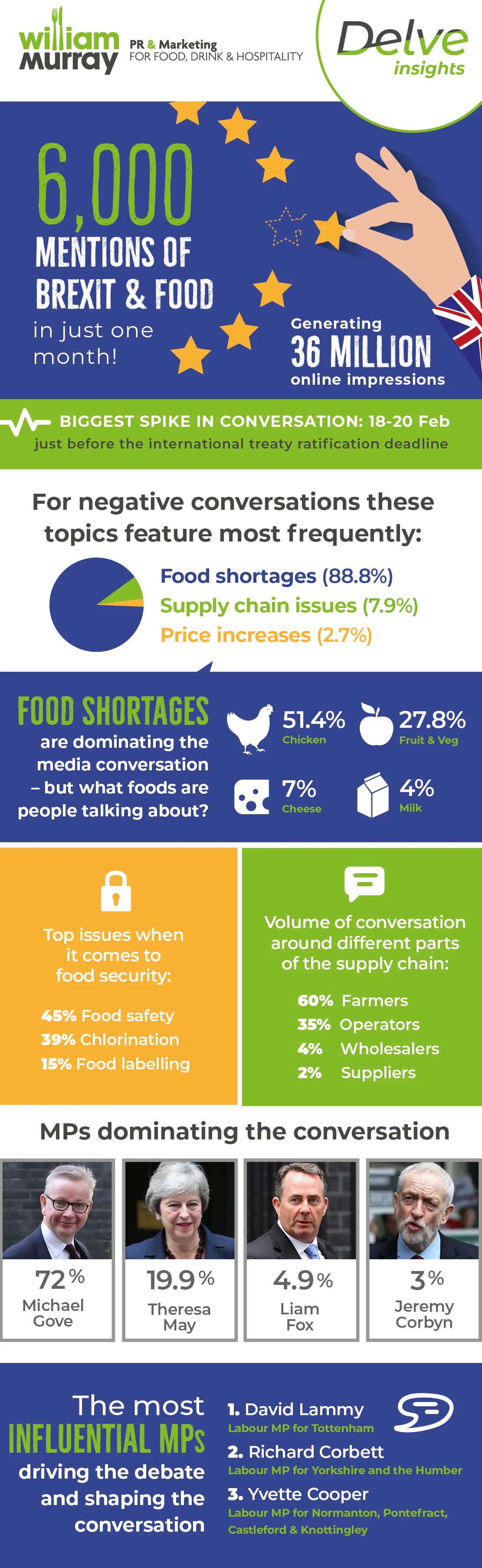
Brexit_Graphic.jpg

Listening is powerful. Insight is priceless.  

Get in touch with our expert team to learn how we can help you gain a competitive edge.    To understand more on what’s being said about you and your competitors, get in touch with our specialist team.

 

News

Hospitality equipment suppliers back industry call for 10% VAT

June 2026

Foodservice and hospitality equipment suppliers have added their support to an industry-wide call for VAT in hospitality venues to be cut to 10%.

High-speed oven manufacturer Merrychef and water filter specialist BRITA Professional have backed #VATsTheProblem, an initiative spearheaded by chef Tom Kerridge calling on the government to reduce VAT for hospitality venues from 20% to 10%.

Merrychef managing director Colin Lacey said: “Operators are facing what can only be described as a relentless accumulation of cost pressures. Since Covid, the sector has absorbed significant increases in energy costs, wage inflation, National Insurance contributions and wider operating expenses, all while consumers themselves are becoming more cautious with spending.

“From our conversations with customers, the challenge isn’t a lack of ambition, it’s confidence. Businesses are being asked to grow and modernise at a time when the cost of doing business continues to rise. For many operators, it feels like death by a thousand cuts.

“Hospitality is one of the UK’s most important industries, creating jobs, supporting communities and driving economic activity. We believe measures that improve cash flow and encourage investment are critical to the sector’s future, which is why Merrychef supports the industry’s call for a reduced VAT rate for hospitality through the #VATsTheProblem campaign.”

The petition, which has more than 200,000 signatures, calls on the government to bring hospitality VAT in line with European countries such as France, Spain and Italy, where it is 10%.

BRITA Professional UK sales director Samantha Scoles added: “At BRITA, we work closely with hospitality operators, and we see first-hand the pressures they are facing. Rising costs, tighter margins and increasing operational demands continue to challenge businesses across the sector. At the same time, we see the vital role hospitality plays in communities, local economies and employment.

“We support initiatives that help create a more sustainable environment for operators to invest, grow and continue delivering exceptional experiences to their customers. That’s why we are proud to support the #VATsTheProblem campaign and the call for a 10% VAT rate for hospitality.”

Kerridge highlighted the breadth of the initiative. “This campaign reaches far deeper than just the front-line positioning of pubs, restaurants, coffee shops, bars and hotels,” he said. “We all know that hospitality is built upon relationships with supply chains. These are building blocks that the individual businesses are built upon. So, whilst this campaign hits the front end, it makes a big difference to everybody who is working or has an attachment with hospitality. We continue to thank the supply chains for all of their support.”

William Murray CEO Anita Murray encouraged the industry to get behind the initiative and support hospitality businesses.

She said: “If you haven’t signed the petition yet, now is the time. Let’s help take this campaign beyond one million signatures and send a clear message that hospitality businesses need more support.”

The campaign is also supported by major hospitality groups, including UKHospitality, the British Beer and Pub Association, the British Institute of Innkeeping and CODE Hospitality.

To sign the petition, click here.

(Image credit: AnnaNahabed)

Insights & Trends

Why it’s time to stop selling products and start solving kitchen problems 

April 2026

By Fiona Hamilton, director of strategic growth 

As the conflict in the Middle East continues to disrupt supply, food inflation remains high, and consumers spend more cautiously, pressure is increasing on foodservice buyers.  

The impact is clear: less time, tighter margins, and little appetite for just another product pitch. 

Buyers need solutions that work in the reality of a busy kitchen. And that shifts the role of marketing and how we sell. For those that want to win, it becomes less about pushing products harder and much more about showing how you solve real operational challenges. 

The brands cutting through are starting with the problem – labour, consistency, cost, speed, additional profit potential – and showing where their products can help. 

Get that right and buyers don’t just see your product. They see it working in their world. Which is much more likely to result in a ‘yes’. 

How to reframe your narrative: 

Start with your USP – but make it relevant
Differentiation still matters, but only if it connects to a real need. Don’t just ask what makes you different; ask why that difference matters in a busy kitchen. If it doesn’t save time, reduce stress, improve consistency or drive profit, it’s not your strongest story. 

Prove there’s demand
Buyers are risk-averse so demonstrate that your product is already resonating with consumers. Use strong social proof to build immediate trust and credibility. That could be usage data (“9 out of 10 consumers would choose X”), or compelling consumer testimonials. 

Highlight your operational edge
Focus on tangible improvements your solution delivers in practice: faster service, simpler prep, lower costs, or improved labour efficiency. The clearer the day-to-day advantage, the stronger your proposition. 

Quantify the commercial impact
Show how your offer improves performance where it matters most – margin, throughput, or meal-time spend. Wherever possible, give numbers to it to turn interest into a clear business case. 

Speak your buyers’ language
Lose the brand jargon. Step into their world – whether that’s the kitchen or boardroom. Talk covers, wastage, labour constraints and service pressure. When buyers feel understood, they’re far more likely to engage. 

At its core, this approach is about reducing risk. The more proof you provide, the easier it is for buyers to make a decision. Then the faster your sales team can move. 

Create your selling story 

If you need help shaping your brand narrative, let’s talk.